A Message from Fr. Andrew
My Dear Friends:
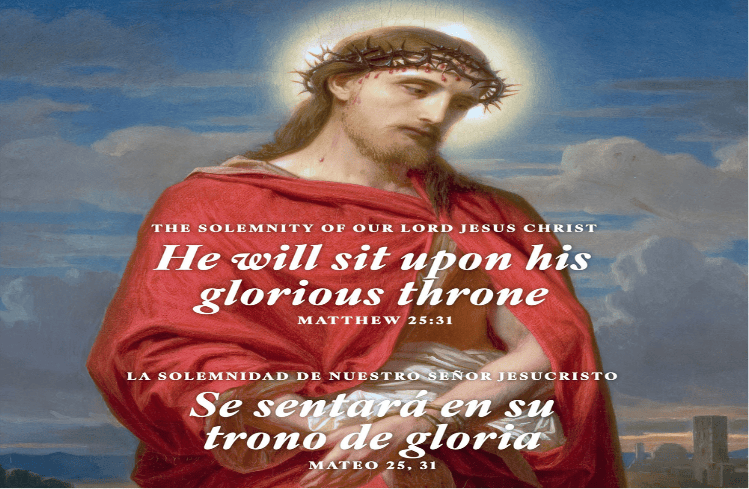
This weekend the Church celebrates the solemnity of Christ the King. Placed at the end of the liturgical calendar, this feast reminds us that while earthly kingdoms rise and fall, Christ reigns forever.
Pope Pius XI instituted this solemnity in 1925 through his encyclical Quas Primas, responding to the rise of secularization, ultranationalism, and anti-Catholicism. He sought to affirm a fundamental truth: Christ alone is sovereign. Governments and ideologies rise and fall, but Christ remains King and Lord, and all humanity will one day answer to him at the Last Judgment.
The truth of Christ’s sovereignty also challenges a temptation that all of us can fall into, regardless of political affiliation: the temptation to immanentize the eschaton. The eschaton refers to the fulfillment of God’s plan for humanity: the moment when his Kingdom is fully realized and all who belong to it will live in perfect peace. To immanentize the eschaton is to falsely believe that we can bring about this perfection through our own efforts, particularly through political systems or ideologies. It is to expect from earthly power what only God can accomplish.
This helps explain the hostility that characterizes our political discourse. When we become convinced that our principles and preferred political solutions will bring about a better, more just society, those who disagree with us can begin to appear as obstacles to that vision. We no longer see them simply as fellow citizens with whom we disagree but as enemies standing in the way of the world we hope to create. We place our hopes in political victories and direct our contempt toward those who threaten them.
But politics is not a god. No party, pundit, or ideology can offer us salvation. The Kingdom of God cannot be legislated into existence; it begins with the conversion of our hearts. Laws can protect human dignity and promote the common good, but they cannot transform the human heart. This is not to say that Catholics should withdraw from civic life. We are called to participate in society and contribute to the common good (CCC 2239). Yet our ultimate allegiance belongs to Christ and his Kingdom. As the Catechism reminds us, Christians live as citizens of their nations while also being “resident aliens” whose way of life surpasses the laws of earthly kingdoms (CCC 2240).
In Quas Primas, Pius XI explains what it means to submit to Christ’s kingship: Jesus must reign in our minds, wills, hearts, and bodies (no. 33). When Christ reigns within us, we begin to reflect his Kingdom in the world around us. We seek justice, love our neighbors, and pursue peace because these are the very things Christ taught and lived.
If we have placed our hope in a party, pundit, or ideology, demonized our neighbors or harbored contempt for those who disagree with us, then this solemnity invites us to repent. The peace our hearts long for will not come from the ballot box but from taking up the yoke of Jesus, which is easy and light (Mt 11:30). We find that peace by allowing him to reign in our hearts and by living as faithful citizens of his heavenly kingdom.
God Bless You All,
Fr. Andrew